




Ecommerce tax planning requires proactive, year-round strategy rather than backward-looking preparation. Since the 2018 South Dakota v. Wayfair ruling, online sellers face multi-state sales tax obligations that demand careful compliance. Fortress Accounting helps founders reduce tax liability legally, plan for cash needs, and avoid filing-season surprises through continuous review of financial numbers.
Key Takeaways
Proactive tax planning reduces liability before year-end, while standard preparation only reports past transactions.
The 2018 South Dakota v. Wayfair ruling requires online sellers to manage multi-state sales tax compliance.
Economic nexus thresholds trigger sales tax obligations when a business surpasses a state’s defined sales volume or transaction count.
Entity structure review confirms the legal formation still fits current revenue levels and affects tax obligations.
What is a proactive tax roadmap for ecommerce startups?
A proactive tax roadmap anticipates obligations before they trigger penalties. Ecommerce startups face unique challenges from multi-state sales tax compliance and diverse revenue streams, making advance planning essential rather than optional. Tax planning focuses on reducing liability before the year ends, while standard preparation merely reports what already happened.
Without a forward-looking strategy, founders miss deductions and face cash crunches during filing season. Statista reports global e-commerce sales reached nearly $6 trillion in 2023, with U.S. sales projected to surpass $1 trillion by the end of 2024. That scale demands disciplined financial oversight.
What does a tax roadmap include for an online seller?
A complete roadmap integrates several interconnected components:
Sales tax nexus analysis across every state where the business has economic presence
Revenue stream categorization that separates product sales, subscription income, and marketplace payouts
Quarterly estimated tax calculations aligned with actual cash flow rather than last year’s figures
Entity structure review to confirm the legal formation still fits current revenue levels
Deduction planning timed to capture equipment purchases, inventory costs, and R&D credits before year-end
Each component connects directly to the next. Miss one, and the entire plan weakens.
How does proactive planning differ from year-end filing?
Year-end filing reconstructs history. Proactive planning shapes it. Fortress Accounting delivers Startup Tax Planning Servicesthat help founders reduce liability legally and allocate cash reserves before deadlines arrive. The company provides strategic financial guidance so businesses scale with confidence instead of scrambling during tax season. Founders who wait until January to assess their position surrender options that closed months earlier.

How do you structure your entity for tax efficiency?
Entity structuring is a foundational step for tax planning. The right structure affects liability exposure and tax obligations. E-commerce founders face diverse revenue streams, cross-border sales, and evolving regulations. A poorly chosen entity type locks in unnecessary tax burdens.
Startup Tax Planning Services begin with entity selection. LLCs and S-Corps treat income differently. Each structure changes available deductions and self-employment tax exposure. Fortress Accounting provides fractional CFO services to guide founders through this decision. High-level financial strategy without the full-time cost.
What entity types work best for e-commerce sellers?
Evaluate liability exposure first. Product sellers carry inventory risk. An LLC separates personal assets from business claims.
Compare tax treatment across structures. S-Corp elections reduce self-employment tax on distributions. LLCs offer pass-through simplicity.
Revisit entity choice annually.
When should a founder restructure the entity?
Restructuring makes sense when tax obligations shift materially. Cross-border sales trigger new compliance requirements. Fortress Accounting reviews entity fit as part of ongoing financial strategy. Smart financial structuring supports long-term security.
How do you manage multi-state sales tax compliance?
Managing multi-state sales tax compliance begins with understanding economic nexus thresholds. Since the 2018 South Dakota v. Wayfair ruling, most states require online businesses to collect and remit sales tax when sales volume or transaction count exceeds state-defined limits. Ecommerce founders operating across state lines face obligations even without a physical presence in those jurisdictions.
What triggers sales tax obligations in multiple states?
Sales tax obligations trigger when a business surpasses a state’s economic nexus threshold. An ecommerce company may need to collect sales tax in states lacking physical offices or warehouses if sales reach that state’s required level. Fortress Accounting identifies these triggering events through systematic revenue monitoring.
The risk of missing a threshold carries real consequences. Uncollected sales tax creates liability that accumulates with each transaction. States actively enforce compliance, and retroactive assessments often include penalties and interest that strain operating capital.
Startup Tax Planning Services through Fortress Accounting help founders avoid these pitfalls. The company’s cloud-based, nationwide service model tracks obligation triggers across all jurisdictions where a business has customers. This proactive monitoring prevents compliance gaps before they widen.
How can ecommerce businesses streamline multi-state filing?
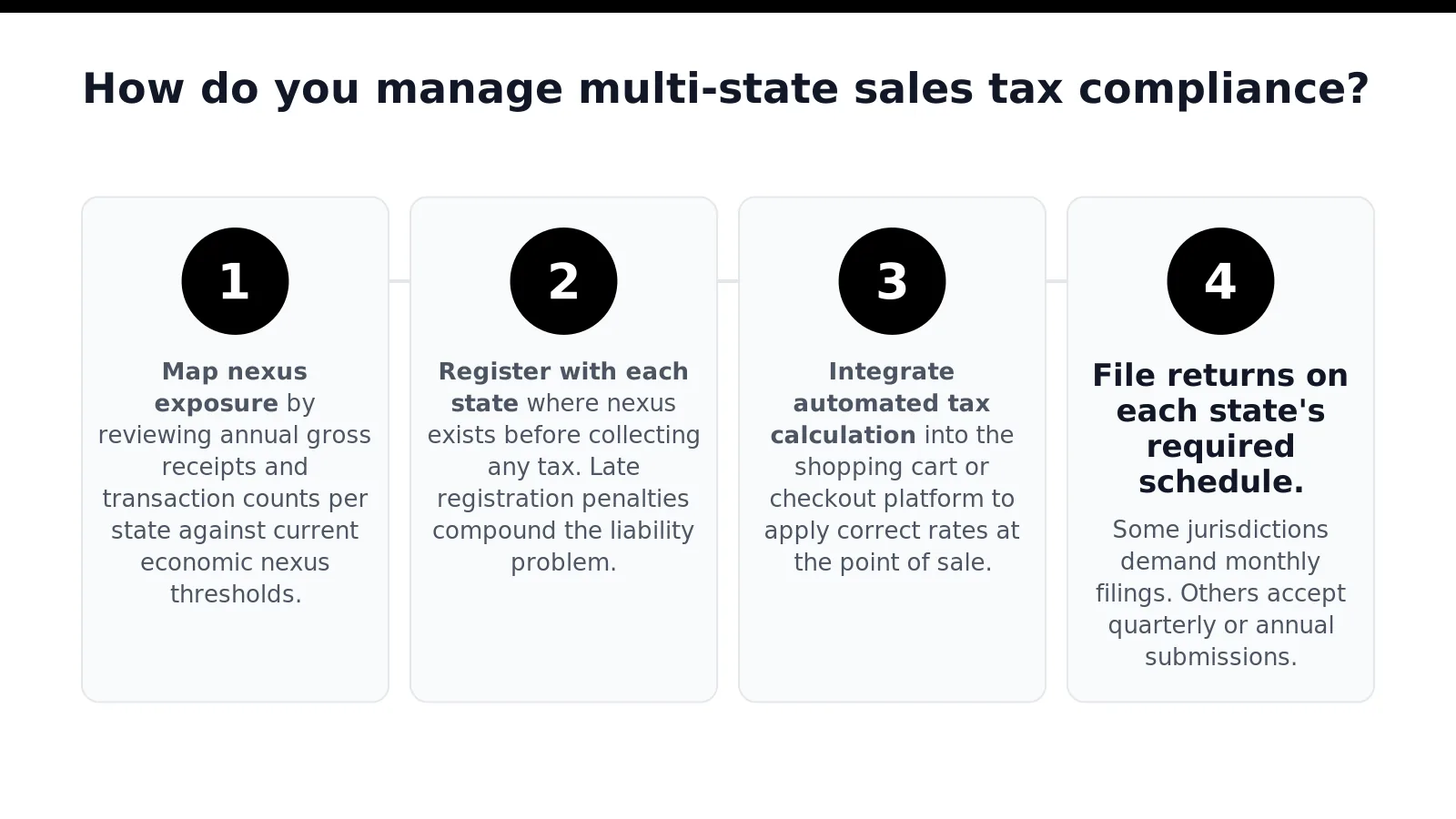
Streamlining multi-state filing requires a structured approach. Founders should follow four concrete steps:
Map nexus exposure by reviewing annual gross receipts and transaction counts per state against current economic nexus thresholds.
Register with each state where nexus exists before collecting any tax. Late registration penalties compound the liability problem.
Integrate automated tax calculation into the shopping cart or checkout platform to apply correct rates at the point of sale.
File returns on each state’s required schedule. Some jurisdictions demand monthly filings. Others accept quarterly or annual submissions.
Proper eCommerce accounting and bookkeeping systems capture the transaction detail needed for accurate multi-state reporting. Fortress Accounting structures these workflows so growing brands maintain compliance without diverting attention from core operations.
What high-impact deductions and credits should you claim?
E-commerce businesses unlock significant tax savings through often-overlooked deductions and credits. Missing these opportunities leaves thousands of dollars on the table every fiscal year.
What everyday business costs are fully deductible?
Operational expenses form the backbone of e-commerce deductions. Advertising costs, shipping fees, and software subscriptions all qualify as legitimate write-offs. These recurring costs reduce taxable income directly when properly documented throughout the year.
Can technology development generate tax credits?
Startups building proprietary software or custom platforms should pursue R&D tax credits aggressively. Fortress Accounting identifies qualifying development activities that many founders overlook. The credits often translate to substantial annual savings for companies investing in technical innovation.
How does proactive planning maximize savings?
Fortress Accounting helps businesses uncover every opportunity to save through structured Startup Tax Planning Services. The company reviews financials throughout the year rather than scrambling at year-end. This forward-looking approach catches deductions before deadlines pass and prevents costly compliance gaps.
Strategic tax planning transforms routine expenses into powerful savings tools. E-commerce operators who claim all eligible deductions and credits preserve capital for inventory, marketing, and scaling operations.
FAQ
What is a proactive tax roadmap for ecommerce startups?
A proactive tax roadmap anticipates multi-state sales tax obligations and reduces liability before year-end. Standard preparation only reports past transactions.
How does proactive planning differ from year-end filing?
Proactive planning shapes obligations legally before deadlines. Year-end filing only reconstructs history and surrenders deduction options that closed months earlier.
How do you structure your entity for tax efficiency?
Entity structure review confirms the legal formation fits current revenue levels. Different structures like LLCs and S-Corps change available deductions and tax obligations.
Conclusion
Proactive tax planning transforms compliance from a year-end scramble into a strategic advantage. Ecommerce founders who structure their entity correctly, monitor multi-state obligations, and claim every eligible deduction preserve capital for growth. Take these steps now to build a tax strategy that supports your business through every stage of scaling.