


This is the first real 1099-DA season, a new information return from the IRS, and a lot of forms are already causing bad returns. If you searched for a cryptocurrency accounting answer, or even typed “rypto accountant” in a hurry, the short version is simple: your broker’s form is often incomplete. For 2025 activity filed in 2026, many brokers report gross proceeds only, while cost basis is missing, delayed, or flat-out wrong under these new reporting requirements.
That happens because a broker only sees its slice of the digital asset story. It doesn’t see the ETH you bridged from Arbitrum to Base, the SOL you moved in from self-custody, or the swap you made on Uniswap before sending assets to Coinbase. Whether you use software or a cryptocurrency accounting firm, you still need to verify the form before you file.
Why 1099-DA for Digital Asset Proceeds Breaks Once Assets Move Across Wallets and Chains
The IRS built Form 1099-DA for broker transactions to give it broker-side visibility, not to build your ledger. The IRS draft instructions for Form 1099-DA make that clear. For first-year reporting, brokers generally send a form for 2025 sales with proceeds, while basis reporting ramps up for 2026 trades filed in 2027. In plain English, the form can be accurate from the broker’s seat and still be wrong for your return.
A common example looks like this. You buy ETH on Kraken in 2023, move it to MetaMask, bridge it to Base in 2025, then send part to Coinbase for dispositions. Coinbase may only see an inbound deposit and dispositions. If it has no basis history, it may show zero basis or nothing useful at all. The same problem hits Solana wallets, wrapped assets, and partial fills across multiple venues.
Basis tracking will get better, not easier. Starting with later reporting, brokers may include adjusted basis, but they still track it wallet by wallet and platform by platform. So a transfer from self-custody into an exchange still needs proof. If you sold on a foreign exchange, you still report it even without a form.
If your return matches the 1099-DA but not your records, the return can still be wrong.
Users on Coinbase and Kraken have also seen first-year delays, with some forms arriving close to filing season and potentially requiring a corrected form if errors persist. That lines up with recent coverage in The Tax Adviser. Meanwhile, self-custody wallets, foreign exchanges, and most activity on decentralized exchanges still won’t hand you a complete tax packet.

That gap is why crypto bookkeeping starts with on-chain reconciliation, not the broker PDF. Once you add Ethereum, Solana, Arbitrum, Base, and a few exchange accounts, you need real multi-chain reconciliation.
The broker mistakes we see most, and the fixes that actually work
These are the errors that blow up returns and monthly closes.
| Broker mistake | What it looks like | Fix |
|---|---|---|
| Transferred-in assets show no cost basis | Deposit from wallet, then sale, gain looks inflated | Trace original buy date, price, fees, and cost basis from source wallet or exchange |
| Bridge or wrap activity gets misread | ETH to WETH, Arbitrum to Base, or similar movement looks taxable | Exclude non-taxable events; mark internal transfers before calculating gain |
| Fees and partial fills are missing | DEX swap or market order doesn’t tie to proceeds | Rebuild trade lots and cost basis from on-chain data and exchange exports |
| Off-broker activity is absent | Uniswap, foreign exchange, or self-custody sales never appear | Add wallet history and file from full records, not the form alone |
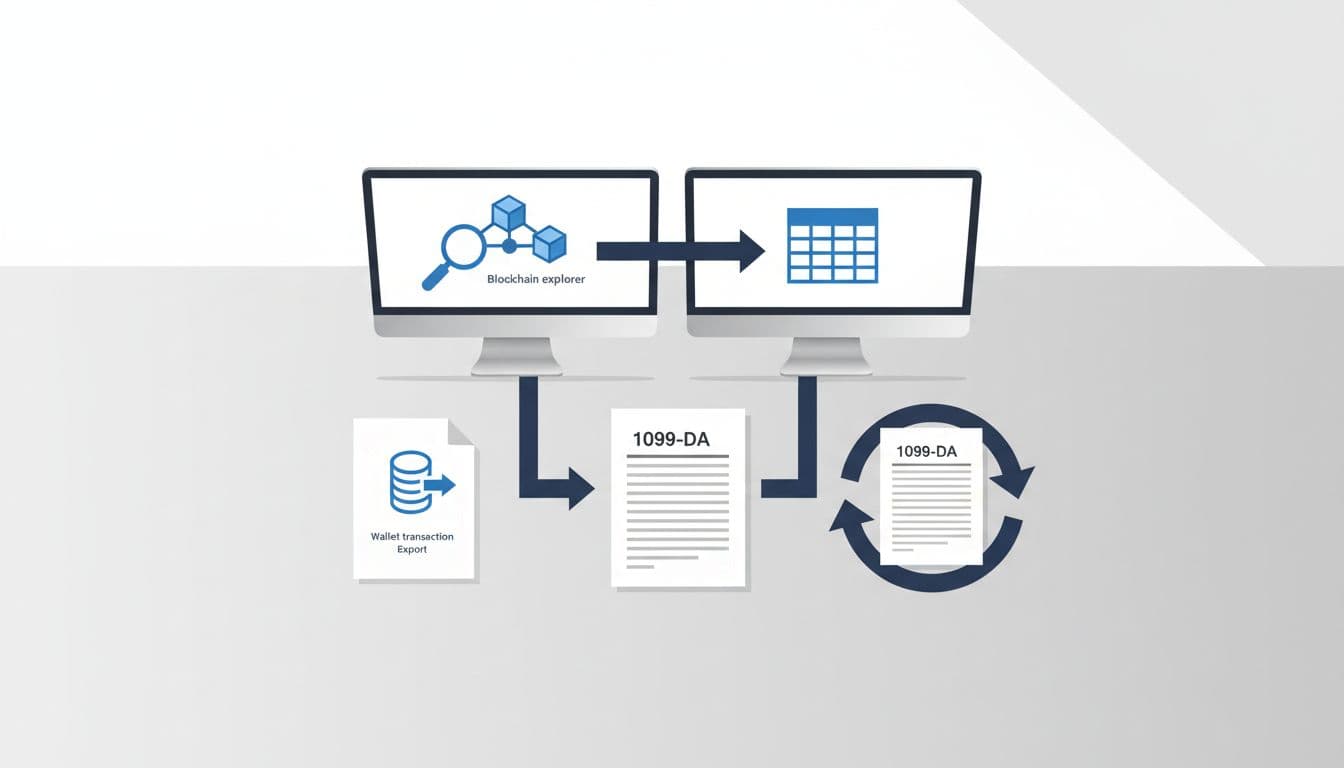
The fix is boring, but it works. Export data from Coinbase and Kraken. Pull transaction history from Etherscan, Basescan, Arbiscan, or Solscan. Then map transfers, bridges, wraps, failed transactions, and fees before you touch Form 8949. Tools like CoinTracker, Cryptio, and Tres Finance can speed this up, but someone still has to review the subledger and push clean entries into QuickBooks Online.
In a common scenario, a founder sells tokens on Coinbase after months of activity on Base and Uniswap. The exchange form looks clean, but the books aren’t. Once you match bridge hashes, gas, and internal transfers, the gain can move fast.
Think of 1099-DA as a receipt printer, not a ledger. Real digital asset accounting, blockchain accounting, DEX reconciliation, L2 accounting, cross-chain accounting, crypto subledger management, crypto treasury reconciliation, and wallet reconciliation services happen in the reconciliation layer to determine capital gain or loss and produce aggregate totals for Form 8949 and Schedule D.
Income makes it messier. A broker form doesn’t solve staking accounting, mining activity, NFTs, airdrop accounting, token accounting, stablecoin accounting, or DeFi yield farming accounting. It also doesn’t answer how to account for staking rewards. For that, you need a written policy, clean timestamps, and supportable fair market values. A quick review of common 1099-DA filing mistakes shows how often these gaps lead to bad returns.
Why Form 1099-DA Fails When Assets Move Across Chains
For founders, 1099-DA is a tax input for digital assets, not crypto financial reporting. If you’re running Web3 accounting, DeFi accounting, crypto startup accounting, Web3 bookkeeping, or token project bookkeeping, the books still need to reflect treasury activity, gains, losses, and income by wallet and entity for each digital asset. That’s why crypto bookkeeping for startups usually breaks when the team treats exchange statements or brokerage reporting as a source of truth.
The accounting rules don’t match the tax form, either. Under FASB ASU 2023-08, GAAP crypto accounting uses fair value for eligible crypto assets, which is separate from broker tax reporting. If your group also reports under IFRS digital asset reporting, you need a clean bridge between tax data and book data for federal income tax and your tax return. The same goes for crypto fund accounting and stablecoin treasury management.
Licensed operators have another layer, including considerations for foreign brokers. Money transmitter accounting, MTL accounting, MSB accounting, and crypto accounting for money transmitters depend on complete books, not just realized gains. FinCEN rules and state MTL exams care about customer liabilities, safeguarding, reserve balances, and exception handling. If a payment company moves USDC across wallets and chains, stablecoin accounting has to tie out daily.
As volume grows, the process matters more than the form. We usually recommend a wallet map, monthly close for data quality, chain-by-chain review, and written policies for lot relief, income recognition, and internal transfers. That’s where fractional CFO crypto support and crypto controller services pay for themselves.
In short, 1099-DA is helpful, but it isn’t your truth. Fix the books first, then tie the tax return back to the 1099-DA form. Prepare your tax return by ensuring everything aligns properly. If you want help cleaning up your records across exchanges, wallets, and protocols, book a free consultation.